
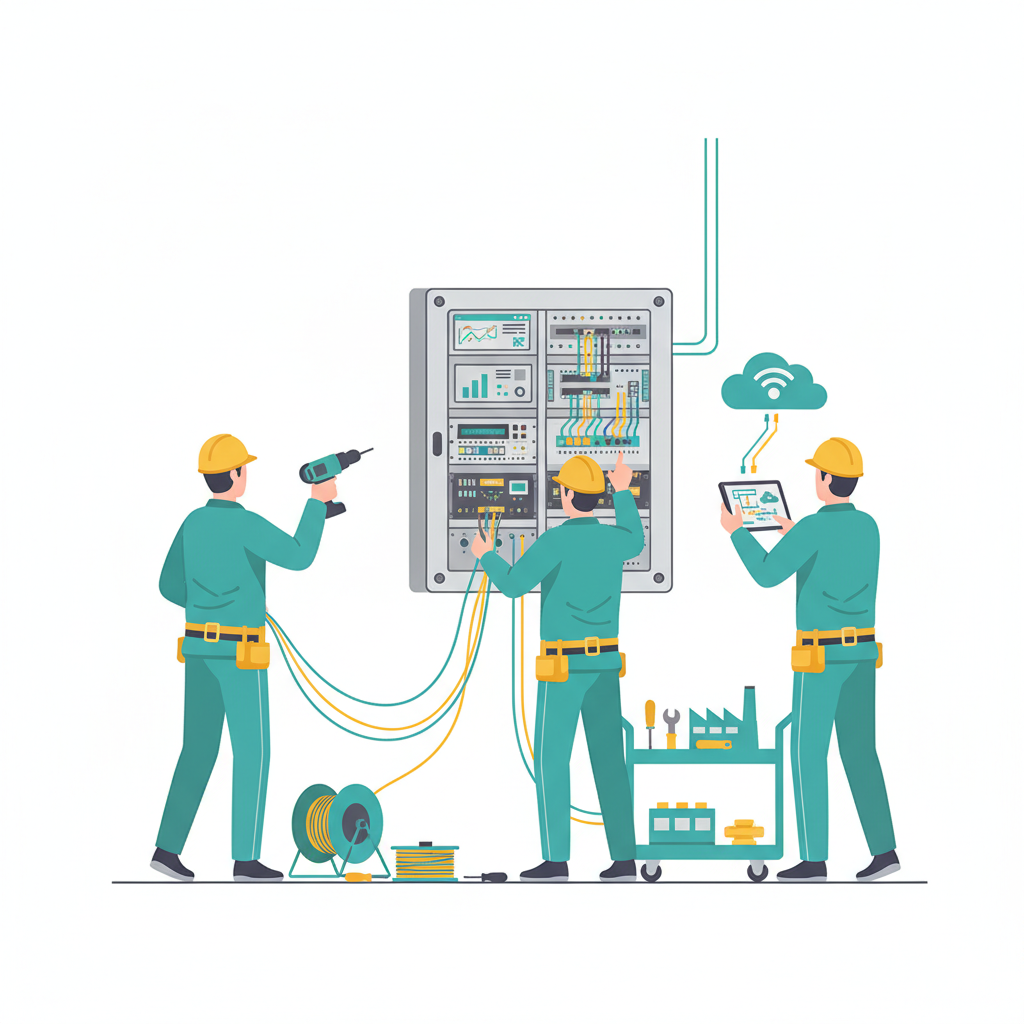
Why Conventional Panels Need an Upgrade
Many production facilities still rely on manual distribution panels designed over a decade ago. These panels typically depend on contactors, relays, and mechanical timers. As production lines expand and monitoring demands grow, the manual approach becomes a bottleneck.
Migrating to PLC-based automation panels delivers tangible advantages:
- Real-time visibility — operators can monitor every circuit breaker and load from a single HMI screen.
- Coordinated protection — PLC logic enables trip scenarios and interlocks far more precise than conventional relays.
- Operational data — alarm logs, runtime counters, and energy consumption are recorded automatically for further analysis.
Our Recommended Migration Steps
1. Load Audit and Single Line Diagram
Before designing a new panel, inventory every connected load. Ensure the single line diagram (SLD) reflects actual site conditions, not just the original commissioning documents.
2. Define the Control Architecture
Choose between a compact or modular PLC depending on I/O count and communication requirements. For smaller facilities, a compact PLC with expansion modules is often sufficient.
3. Panel Layout Design
The layout must account for service access, ventilation, and segregation of power versus signal paths. We typically place PLCs and signal terminals in the upper section, with MCCBs and power contactors below.
4. Fabrication and Testing
Assembly happens in our workshop following consistent wiring standards: permanently labeled cables, tidy routing, and documented terminals. Before shipment, every panel undergoes a Factory Acceptance Test (FAT) covering continuity, logic simulation, and alarm verification.
5. Installation and Commissioning
On-site work includes panel placement, inter-panel cable pulls, utility connections, and a final Site Acceptance Test (SAT). Operators receive a focused briefing on HMI navigation and emergency procedures.
Timeline and Cost Estimates
A single-panel migration project typically takes 4-8 weeks from design through commissioning. Costs depend heavily on I/O count, component brands, and whether installation is handled internally or by our field team.
Contact us for an initial consultation — we are ready to help calculate estimates based on your SLD and load schedule.